
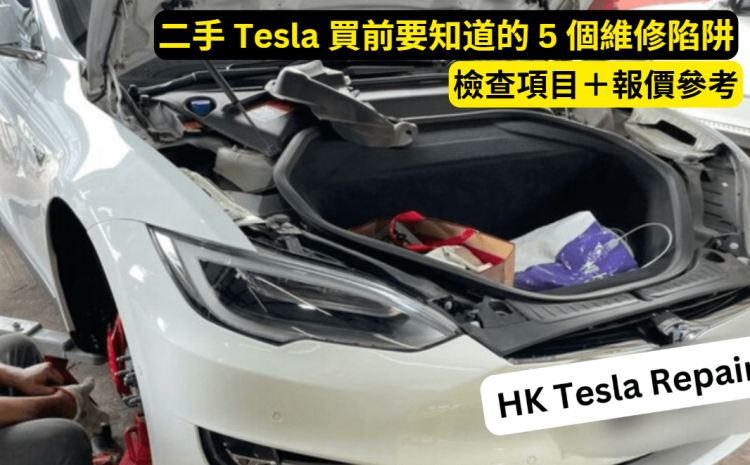
5 Repair Pitfalls to Know Before Buying a Used Tesla | Inspection Checklist + Quotation Reference
As electric vehicles become increasingly popular, used Teslas have become a popular choice for Hong Kong car owners looking to trade up to a new car or enter the EV market. However, before buying a used Tesla, price and year are not the only things to consider; potential repair pitfalls should not be overlooked either. This article will analyse five common repair risks in depth and provide professional inspection items and quotation references to help you avoid commonpitfalls and enjoy greater peace of mind when buying. Whether it is a Tesla Model 3, Model Y, Model S or Model X, owners should understand these key points to safeguard their car’s value and safety.
Current State of the Used Tesla Market and Buying Trends
As the EV penetration rate in Hong Kong continues to rise, the used Tesla market is becoming increasingly active. In recent years, more and more car owners have chosen to buy used Teslas, not only enjoying the low costs and high-tech driving experience that EVs bring, but also getting their desired model at a more affordable price. The following will analyse in detail the current state of Hong Kong’s used EV market, Tesla models’ popularity in the used car market, and the common pitfalls when buying a used Tesla, to help you make an informed choice.
Overview of Hong Kong’s Used EV Market
As Asia’s financial centre, Hong Kong continues to see growing demand for sustainable development and environmentally friendly transport. Electric vehicles, especially Tesla, have seen significant growth in both the new and used markets in recent years. According to Transport Department data, in 2023 Hong Kong’s EV registrations exceeded 60,000 vehicles, with Tesla holding a dominant position. As the government promotes its ‘zero emissions’ policy and fuel vehicles are subject to higher taxes, more and more car owners are switching to the EV market, driving demand for used Tesla resales.
The market is currently made up mainly of the following types of car owners:
- Tesla owners upgrading to a newer model
- First-time EV buyers
- Owners seeking better value for money
The table below lists the registration numbers and used-market shares of major EV brands in Hong Kong in recent years:
| EV Brand | Registrations (2023) | Used Market Share |
| Tesla | 42,000 | 65% |
| BYD | 8,500 | 12% |
| Nissan | 3,200 | 7% |
| BMW | 2,700 | 6% |
| Other | 3,600 | 10% |
An active second-hand market means buyers have more choice, but it also carries certain risks. Tesla’s high-tech features in particular make the inspection and repair process especially important.
Recommended reading:
Must-read before buying a used electric vehicle: a complete guide to inspection checklists and avoiding common pitfalls
Why used Tesla models are so popular
In Hong Kong’s second-hand EV market, Tesla has long remained at the top of the best-selling models. Its unique advantages stem from innovative technology, outstanding performance and a comprehensive charging infrastructure, attracting a large number of buyers. Below is a detailed analysis of why various used Tesla models are popular:
- Model 3: the value-for-money choice
Model 3 is known for its accessible entry price and practical performance, making it the top choice for many first-time EV buyers. Its range, acceleration and intelligent driving features are all world-class, with ample supply on the second-hand market and relatively reasonable repair and maintenance costs. - Model Y: family and multi-purpose needs
The Model Y has a spacious cabin, making it suitable for families or users who need large storage capacity. As an SUV, it combines high safety and versatility, and is also one of the fastest-growing Tesla models by second-hand market sales in recent years. - Model S and Model X: luxury and performance combined
The high-end Model S and Model X are the first choice for premium buyers, thanks to their exceptional performance, luxury features and longer range. Although new car prices are higher, second-hand price discounts are substantial, allowing many users to enjoy a flagship-level electric vehicle experience at a lower cost.
Tesla Key comparison table of second-hand models:
| Model | Price range (HKD) | Range (km) | Key selling points |
| Model 3 | $220,000-$350,000 | 430-580 | High value for money, smart technology |
| Model Y | $300,000-$420,000 | 455-505 | Spacious, versatile SUV |
| Model S | $350,000-$600,000 | 530-652 | Luxurious, long range, high performance |
| Model X | $400,000-$700,000 | 507-565 | Seven seats with generous space, luxury features |
Beyond the models themselves, Tesla has an extensive Supercharger network and software upgrade capability in Hong Kong, further enhancing the appeal of a used Tesla.
Tesla Official website – Hong Kong
Common misconceptions about buying a used Tesla
Although used Teslas offer many advantages, many buyers still fall into traps due to a lack of information. The following outlines several common misconceptions to help you avoid unnecessary losses:
- Ignoring battery health
The battery is the core component of an electric vehicle, and neglecting it can lead to high repair costs later. Many buyers focus only on mileage while overlooking the battery’s true health. You should insist that the seller provide a full battery inspection report, or have the battery checked yourself at a professional Tesla repair centre. - Not reviewing repair and maintenance records
Some used Teslas lack complete official repair records or have undergone non-official repairs, both of which can affect vehicle safety and make subsequent maintenance more difficult. Choose a vehicle with good repair records and a clear maintenance history. - Overlooking software and self-driving functionality
A used Tesla’s software upgrades and self-driving features may be restricted due to a change of owner or past settings. Before buying, confirm that the relevant features work properly and check whether the latest software has been enabled. - Chasing a low price while ignoring potential repair costs
Some sellers attract buyers with a low price, but the vehicle may have been involved in a serious accident or have hidden problems. Do not decide based on price alone; make transparent vehicle condition and a thorough inspection your first priority.
| Common misconceptions | Potential risks | Preventive advice |
| Ignoring battery health | High replacement costs, reduced range | Professional battery inspection |
| No repair records | Safety risks, maintenance difficulties | Check official maintenance records |
| Software/self-driving issues | Limited functionality, upgrade difficulties | Test all features in person |
| Focusing only on price | Many hidden risks, unpredictable follow-up costs | Detailed vehicle condition inspection |
Recommended reading:
Tesla Complete Guide to Battery Health Checks | How to Assess a Used Battery’s Condition and Prevent Costly Repairs
A Full Breakdown of Used Tesla Repair Pitfalls
Buying a used Tesla lets you enjoy the electric driving experience at a favourable price, but overlooking potential repair pitfalls can lead to costly repairs or safety risks later on. The following sections examine in depth the five most common repair pitfalls of used Teslas, helping you make a thorough assessment before you buy and protecting both your investment and driving safety.
Battery Health and Replacement Costs
The battery is the core component of a Tesla electric vehicle, directly affecting range, driving experience and subsequent repair costs. If a used Tesla’s battery health has not been professionally checked, buyers can easily overlook minor degradation and end up facing substantial replacement costs.
Why Is Battery Health So Important?
As the number of charge and discharge cycles increases, battery capacity gradually degrades. If the previous owner frequently used fast charging or regularly ran the battery low, degradation may accelerate, causing a significant drop in range and possibly requiring the entire battery pack to be replaced.
Common Used Tesla Battery Problems:
- Range noticeably lower than the manufacturer’s rating
- Slower charging speed
- Abnormal warning signals appearing
Reference Battery Replacement Costs (Hong Kong):
| Model | New Battery Replacement Cost (HKD) | Used Battery Replacement Cost (HKD) |
| Model 3 | $50,000 – $70,000 | $30,000 – $45,000 |
| Model Y | $55,000 – $75,000 | $32,000 – $48,000 |
| Model S/X | $80,000 – $110,000 | $50,000 – $70,000 |
Professional advice:
Before purchase, you must ask the seller to provide a battery health check report, and have a professional inspection carried out at a third-party centre with Tesla repair experience or by the manufacturer.
Further reading:
Tesla Complete guide to battery health checks | How to assess the condition of a used battery and prevent costly repairs
Potential issues with autonomous driving and software systems
Tesla is known for its autonomous driving and advanced software systems, but when a used car changes hands, these features may not be fully retained or may not operate properly. Some features, such as FSD (Full Self-Driving) or EAP (Enhanced Autopilot), may cease to work due to owner transfer, regional policies or system authorisation. If buyers do not confirm beforehand, they may easily assume that all functions canbe used seamlessly.
Common risks include:
- Software version is too old to receive the latest safety upgrades
- Autonomous driving functions are locked or have their authorisation revoked
- Central touchscreen malfunctions, operating system responds slowly
- Issues with remote vehicle monitoring and mobile phone connectivity
Reference charges for software repairs and authorisation restoration:
| Issue type | Possible cost (HKD) |
| Software licence transfer | $2,000 – $6,000 |
| System reinstallation and upgrade | $1,000 – $3,000 |
| Central touchscreen repair | $6,000 – $13,000 |
Professional advice:
Before purchase, you must test core functions such as autonomous driving, connected car features and voice control on site, and confirm the software authorisation status with the seller.
Tesla Official support – Software and feature transfer information
Body structure and glass damage
Tesla uses a large amount of aluminium alloy and composite materials. Its body structure is lightweight, but repair difficulty and costs are higher than for traditional cars. If a used Tesla has structural damage or glass cracks, it not only affects its appearance but may also affect driving safety and future repair costs.
Common problems include:
- The frame or chassis has previously been repaired after a serious collision
- Cracks in the panoramic glass roof, damage to the front and rear windscreens
- Poor sealing of door frames, doors or the boot
Reference repair costs (common in Hong Kong):
| Repair item | Cost range (HKD) |
| Chassis structural repair | $8,000 – $30,000 |
| Glass roof replacement | $5,000 – $12,000 |
| Windscreen replacement | $4,000 – $10,000 |
Professional advice:
Before purchasing, we recommend a detailed inspection of the undercarriage, chassis and glass structure at a professional repair centre, along with a review of past repair records.
Missing official service and repair records
A complete set of official service and repair records is one of the most reliable ways to assess the condition of a used Tesla. Some owners choose non-official repairs to save costs, or cannot verify past servicing because records have been lost, greatly increasing the potential risk.
Common issues:
- Unable to confirm whether important components (such as the battery or motor) have been replaced
- Unclear repair records resulting in a voided warranty
- Hidden damage is hard to detect, making later repairs more difficult
Official vs non-official servicing comparison table:
| Item | Official servicing | Non-official repairs |
| Record completeness | High | Low or incomplete |
| Repair quality | Standardised, professional | Inconsistent |
| Warranty impact | Maintains the official warranty | May be voided |
Professional advice:
Choose a vehicle with complete repair and service records, and verify their authenticity with the official manufacturer or an authorised repair centre.
Tesla Official – How to check repair records
Risks of non-official parts and repairs
Using non-official parts or having repairs carried out at non-certified repair centres may save money in the short term, but over time it can lead to unexpected safety risks and costly repairs.
Common risks:
- Inconsistent parts quality and poor vehicle compatibility
- Affects the vehicle’s overall performance and hardware and software compatibility
- Potential safety risks, such as faults caused by non-genuine repairs to the braking system, suspension or battery modules
- May invalidate the manufacturer’s warranty
Repair cost comparison table:
| Repair item | Genuine parts cost | Non-genuine parts cost | Potential risks |
| Battery module replacement | High | Low | Safety; warranty invalidation |
| Suspension system | Medium | Low | Unstable compatibility |
| Braking system | Medium | Low | Reduced braking performance |
Professional advice:
Prioritise vehicles with an official repair history and avoid parts of unknown origin or with uncertain quality.
Hong Kong Tesla official repairs vs. third-party repair centres compared | Fees, services and warranty cover at a glance
Essential inspection items and professional advice
When buying a second-hand Tesla, a comprehensive and professional inspection process is crucial. A systematic inspection can effectively uncover potential issues, reduce future repair risks, and safeguard your investment and driving safety. Below are the four essential inspection items and professional advice before buying a second-hand Tesla, to help you buy your ideal electric vehicle with confidence.
Pre-purchase battery and vehicle system inspection
Battery and vehicle system inspections are key to assessing the value and future repair costs of a second-hand Tesla. Battery health not only directly affects range but is also one of the main sources of subsequent repair costs. A professional inspection should cover the following key areas:
- Battery health check: It is advisable to use professional diagnostic equipment (such as Tesla official tools or third-party specialist instruments) to check the battery module’s remaining capacity, charge/discharge cycles, thermal management system function, and battery anomaly records.
- High-voltage system check: Check high-voltage cables, charging port and electronic control unit for abnormal wear or oxidation to ensure battery charging and discharging efficiency and safety.
- Powertrain diagnostics: Check whether the motor, inverter and reduction gearbox operate smoothly, and whether there are any abnormal noises or odours.
| Inspection item | Purpose | Recommended method |
| Battery health | Assess range and lifespan | Read using professional diagnostic equipment |
| High-voltage system | Ensuring safety and efficiency | Visual inspection + instrument testing |
| Powertrain | Preventing major faults | On-site testing by professional engineers |
Professional advice:
Before purchasing, always ask the seller to provide a battery health report, or take the vehicle to a Tesla certified repair centre or an experienced third-party repair centre for a comprehensive inspection.
Further reading:
Tesla Battery Health Check: The Complete Guide | How to Assess Used Battery Condition and Prevent Costly Repairs
Exterior and Chassis Inspection
Inspecting the exterior and chassis is not only about aesthetics; it directly affects driving safety and subsequent repair costs. A used Tesla may have experienced collisions, prolonged sun exposure or rough road conditions, so the body and chassis may show damage.
- Body Paint and Panel Inspection: Check for obvious scratches, dents, colour differences or signs of repainting, paying particular attention to the door edges, wings and the panoramic roof glass.
- Glass and Light Integrity: Check the front and rear windscreens, sunroof and window glass for cracks or signs of repair, and test that all lights function correctly.
- Chassis and Suspension System Inspection: Focus on checking the chassis for rust, abnormal deformation, oil leaks, and whether the suspension and shock absorbers are loose or making unusual noises.
| Item | Details to Note | Professional Advice |
| Body and Paint | Scratches, panel damage, colour differences | Check one by one |
| Glass and Lights | Cracks, functional faults | On-site testing |
| Chassis and Suspension | Corrosion, oil leaks, looseness | Inspect on a lift |
Recommendation:
If structural damage or serious faults are found, consider walking away from the purchase or asking the seller for a price reduction.
5 Repair Pitfalls to Know Before Buying a Used Tesla | Inspection Items + Quote Reference
Software and Hardware Updates and Testing
Tesla is renowned for its OTA (Over-the-air) wireless update technology, and all vehicle software and autonomous driving functions depend on stable system versions. When buying a used car, software and hardware checks must not be overlooked.
- Software Version Check: Confirm that the vehicle has the latest official software installed, and check whether functions such as autonomous driving, Smart Summon and voice control operate correctly.
- Hardware Compatibility and Upgrades: Some older models may not support the latest autonomous driving hardware, so confirm whether a hardware upgrade has been carried out.
- Troubleshooting System Faults: Check whether the central touchscreen, instrument cluster, audio system, navigation, Bluetooth and other devices operate smoothly.
| Software and hardware items | Key test areas | Common issues |
| Software version | Whether it is the latest version | Update failure |
| Autopilot features | Activation status, functional completeness | Missing functions |
| Connected devices | Mobile app, Bluetooth and Wi-Fi connection | Unable to connect |
Professional advice:
Test all smart features on site and check the software and hardware upgrade records, so that licensing issues do not affect future use.
Tesla Official support – Software and feature transfer information
Test drive and professional assessment process
The final step: a professional test drive and assessment process is a vital part of confirming that the vehicle’s performance matches its actual condition. When test driving, focus on the following points:
- Pull-away and acceleration performance: Feel whether power delivery is smooth, and check for lag or unusual noises.
- Braking and steering: Test braking response and steering sensitivity, and watch for abnormal noise or pulling.
- Noises while driving and comfort: Listen for unusual noises from the chassis, suspension and tyres on different road surfaces, and check the damping and sound insulation.
- Instrument cluster and display abnormalities: Confirm that there are no warning lights on the dashboard and that all displayed information is normal.
| Test drive stage | Key test items | Inspection method |
| Power and acceleration | Power output, response speed | On-road test drive |
| Braking and steering | Braking distance, steering accuracy | Testing across multiple road conditions |
| Noises while driving | Chassis, suspension, tyres | Observation in a quiet environment |
| Instrument cluster status | Warning lights and displays accurate | Start all vehicle systems |
Professional advice:
Where conditions permit, it is advisable to engage a third-party professional Tesla inspection company to accompany the test drive and issue a detailed assessment report, safeguarding the security of the subsequent transaction.
Further reading:
Must-read for buying a used electric vehicle: a complete guide to inspection checklists and avoiding common pitfalls
Used Tesla repair quote reference
When buying a used Tesla, in addition to the vehicle price, repair and maintenance costs are also items that buyers must consider as a priority. Understanding common repair items, the differences in quotes from different repair centres, and judging whether a quote is reasonable can effectively help you plan your budget and avoid unnecessary expenses. The following will, for the Hong Kong market, compile the latest used Tesla repair cost reference, and provide professional advice.
Common repair items and cost estimates
As used Teslas vary in age, mileage and maintenance condition, common repair items and related costs also differ. The following lists the main common repair items and approximate cost ranges in the Hong Kong market, to help you have a clear idea:
| Repair item | Cost range (HKD) | Remarks |
| Battery module replacement | $30,000 – $110,000 | Depending on model and condition |
| Drive motor repair/replacement | $8,000 – $30,000 | Includes front/rear motor |
| Suspension and shock absorber repair | $4,000 – $15,000 | Varies by model and wear |
| Glass roof/windscreen | $4,000 – $12,000 | Depends on the part replaced |
| Tyre replacement | $1,800 – $5,000/tyre | Depending on brand and size |
| Centre console screen repair/replacement | $6,000 – $13,000 | Includes software and hardware checks |
| Software system diagnostics/upgrade | $1,000 – $3,000 | Includes authorisation transfer |
| Body panel beating/spray painting | $2,000 – $18,000 | Calculated according to the damaged area |
These costs are for reference only. Actual costs will vary depending on the vehicle model, extent of damage and the quote from the repair centre. It is advisable to obtain quotes from several centres before repairs and to review the repair details.
5 repair pitfalls to know before buying a used Tesla | Inspection items + quote reference
Comparison of official repairs and third-party Tesla repair centres
Tesla owners in Hong Kong can choose to have servicing and repairs carried out at an official repair centre or a third-party specialist repair centre. The choice can affect quotations, parts quality and service assurance. The following compares the main differences between the two:
| Item | Official repair centre | Third-party repair centre |
| Parts source | Genuine original parts | Genuine original or high-quality aftermarket parts |
| Technician qualifications | Tesla-certified technicians | Experienced EV/Tesla technicians |
| Repair pricing | Higher | More flexible; some are more affordable |
| Repairs and warranty | Provides official warranty support | Depends on the centre’s policy |
| Booking lead time | Often requires waiting | Generally more flexible |
| Software/feature upgrades | Can carry out all official upgrades | Some features require official authorisation |
Professional advice:
If the vehicle is still within the official warranty period, it is advisable to choose official repairs wherever possible to safeguard your future repair rights. If it is out of warranty or you need to control your budget, choosing a reputable third-party centre with Tesla repair experience is also a practical option.
Tesla Official repair centre information (Hong Kong)
How to tell whether a repair quote is reasonable
When faced with quotes from different repair centres, how can you tell whether the costs are reasonable? The following points can be used as a reference:
- Compare quotes from multiple repair centres: It is advisable to ask at least two to three reputable repair centres for a quote on the same item. If there is a significant discrepancy in the price range, you should investigate the reason further.
- Check repair details and parts sources: A reasonable quote should clearly set out the parts to be replaced or repaired, labour hours and warranty terms, avoiding ‘low quote then additional charges’ situations.
- Understand market reference prices: You can refer to industry average quotes or publicly available online information, and compare them against the table on this page and other users’ experiences.
- Repair records and quality assurance: Choose a repair centre that can issue a formal repair order and provide quality assurance, to safeguard follow-up tracking and your rights.
- Avoid using cheap parts of unknown origin or unqualified repair technicians, to avoid impacting vehicle safety and future resale value.
| Assessment steps | Key checks | Points to note |
| Compare quotes | Quotes for the same item from multiple centres | Enquire about what is included/excluded |
| Repair details | Parts, labour hours, warranty | Clearly list all details |
| Reference market prices | Compare against this page and industry information | Avoid obvious low-price traps |
| Repair records and guarantees | Formal repair order, warranty terms | Facilitates future tracking |
Hong Kong Tesla official repair vs. third-party repair centre comparison | Charges, services and protection at a glance
The importance of choosing professional Tesla repair services
As Tesla electric vehicles become more popular in Hong Kong, the demand for repair and maintenance is also increasing. Choosing professional Tesla repair services not only affects your car’s performance, but is also directly related to safety and resale value. Whether it is routine maintenance, emergency repairs, or inspections before buying or selling a second-hand car, professional repair centres can provide more comprehensive and reliable technical support and protection. The followingwill explore in depth the importance of choosing professional Tesla repair services.
Advantages of professional repair centres
Professional Tesla repair centres have factory-level equipment, an experienced team of technicians, and strict repair procedures, ensuring that every inspection and repair meets the highest standards.
Main advantages include:
- Accurate diagnosis: Professional centres are equipped with factory diagnostic equipment to instantly test batteries, motors, software and hardware, and safety systems, quickly identifying the root cause and reducing the risk of misdiagnosis or repeat repairs.
- Factory-standard operating procedures: All repairs follow Tesla’s factory technical manuals, ensuring every detail complies with official specifications and improving repair quality and safety.
- Parts quality assurance: We use only genuine or officially certified high-quality parts, preventing compatibility issues or reduced service life caused by aftermarket parts.
- Professional technician team: All technicians are trained to Tesla-certified standards, familiar with the latest models and system upgrades, and able to handle complex faults and advanced features.
- Complete repair records: Detailed records are created for every repair, making it easier to track the vehicle’s condition later and adding credibility when reselling the car.
| Professional Repair Advantages | Notes |
| Genuine Equipment | Precise diagnostics, efficient repairs |
| Experienced Technicians | Highly experienced in handling complex issues |
| High-Quality Parts | Ensuring safety and extending service life |
| Standard Procedures | Operated in accordance with official specifications |
| Complete Repair Records | Boosting used-car value |
Tesla-Certified Repairs and Protection
Choosing Tesla-certified repair services means your vehicle will enjoy original-equipment-level protection and peace of mind.
Key protections include:
- Original Warranty Maintained: All repairs do not affect your existing warranty rights, ensuring the owner retains the right to free repairs or parts replacement in future.
- Full Software Functionality: Certified repair centres can carry out official software upgrades and feature activation, ensuring advanced features such as Autopilot and Smart Summon function correctly.
- Repair Quality Assurance: A clear repair warranty period is provided; if the same area develops a problem, free inspection and follow-up are available.
- Transparent Pricing: Certified centres list all repair items and charging standards in advance, avoiding extra hidden fees.
- Data Security and Privacy: The repair process strictly follows data protection policies, safeguarding the owner’s personal information and vehicle data.
| Advantages of Tesla-Certified Service | Description |
| Warranty Commitment | Maintains the original warranty without affecting rights |
| Software Upgrades | Officially authorised upgrades, full functionality |
| Transparent Pricing | Clear charges, no hidden fees |
| Repair Quality Assurance | Provides a repair warranty period and free follow-up |
| Data Security | Strict compliance with privacy protection policies |
Tesla Official repair and warranty information
Common repair scams and how to prevent them
As demand in the Tesla repair market grows, some unscrupulous repair shops or individuals exploit information asymmetry to carry out various scams or dishonest practices, harming the interests of vehicle owners. Common scams include:
- Falsely reporting faults and exaggerating repair items: When only a simple repair is required, they quote multiple expensive repair items, adding unnecessary costs.
- Using counterfeit or poor-quality parts: They attract customers with low prices but actually install unlabelled or poor-quality aftermarket parts, affecting performance and even compromising safety.
- Falsifying repair records or failing to provide them: They do not provide formal repair invoices, making future disputes difficult to investigate.
- Charging excessive fees or adding last-minute charges: Quotations are not transparent, and costs are added during the repair process, causing serious budget overruns.
Preventive measures:
- Choose a reputable, Tesla-certified professional repair centre.
- Request a detailed repair quotation and itemised list, and keep all formal receipts.
- Refuse unbranded parts of unknown origin.
- Compare quotations from several repair centres, and avoid the trap of prices that are obviously too low or too high.
- Check online reviews or user feedback to raise your awareness.
| Scam scenario | Prevention advice |
| Falsely reported repair items | Request an on-site explanation and old parts to be shown |
| Use of counterfeit parts | Specify original or certified parts |
| No formal receipt | Decline the transaction and choose a professional centre instead |
| Last-minute quotation changes | Confirm all costs and written records |
🧭 Further reading recommendations
-
How best to maintain an EV in Hong Kong's climate? 5 practical tips you need to know
-
A complete guide to Tesla battery life and replacement timing in Hong Kong | When is the best time to replace it? How can you extend battery life?
-
Tesla maintenance costs revealed: an overview of repair expenses by model